- The Defining Moment
- Posts
- The Check That Reset the NFL
The Check That Reset the NFL
The $1.58 billion bid that reset the price of sports television
The Moment
In December 1993, Fox Broadcasting Company won the NFL’s National Football Conference television rights with a bid widely reported at about $1.58 billion. The agreement ran for four seasons beginning with the 1994 season, and it placed a new number on a property that had been treated, for years, as familiar terrain.
Fox was still building its identity as a broadcast network. NFL rights offered a weekly appointment that advertisers could plan around and affiliates could lean on.
Before the Deal
NFL television in that era was associated with the established broadcast networks, and the NFC package in particular was closely identified with CBS. CBS had televised NFL games since 1956, and after the 1970 NFL–AFL merger it became the broadcast home of NFC games for more than two decades.
That history created stability in both presentation and business. The league received mass distribution, and the network received a product that could anchor advertising plans with unusual confidence.
Leverage often looked like distribution and relationships. Networks with entrenched affiliates and mature sales operations could treat NFL rights as essential, while still assuming the center of gravity would remain inside a small, familiar group.
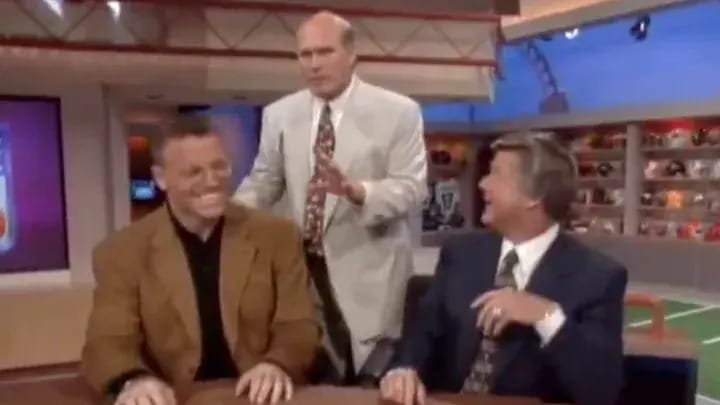
An early NFL on Fox pregame show with a familiar cast of characters (September 4, 1994).
The Break
Fox’s bid interrupted the assumption that these packages would circulate within the same hands. CBS lost the NFC rights after the 1993 season, and the loss was widely described at the time as consequential because the NFL had been a defining weekly presence in its lineup.
The friction was not only the price. The bid suggested that the value of the rights could be argued from a different starting point, one that treated the NFL less as premium programming and more as a platform with consequences for a network’s standing.
For Fox, the number also created immediate operational pressure. The rights were secured on paper, but the credibility of the purchase would be judged through the broadcast itself, week after week.
One visible signal of that urgency came quickly. Fox built its presentation around established NFL voices, including the high-profile move of John Madden and Pat Summerall to call its lead games starting in 1994.
What the Market Became
Once Fox showed it could win the package and present it at the top of the market, the old assumptions stopped holding. The NFL had proof that the bidding circle could expand.
Over time, that altered where leverage sat. The NFL could approach future talks with evidence that networks might pay not only for access, but to avoid being shut out of a national habit that advertisers and affiliates treated as hard to replace.
The effects extended beyond television budgets. As national media rights revenue grew in importance, team finances became more closely tied to the stability of those contracts, and valuations increasingly reflected the scarcity of properties that can deliver a large live audience on schedule.
The Fox bid remains easy to cite because the figure is clean and memorable. The longer-lasting change was less visible, a market that learned to price NFL rights as something closer to infrastructure than programming.