- The Defining Moment
- Posts
- The Game That Turned March Madness Into Appointment TV
The Game That Turned March Madness Into Appointment TV
Bird vs. Magic in 1979 produced a national number that changed what the tournament could be.
Bird, Magic, and a national number
On March 26, 1979, Michigan State played Indiana State for the NCAA men’s basketball championship. Michigan State won 75–64, and a sport that had long been powerful in pockets suddenly looked like it could command the whole country at once.
The game worked as television because it was easy to understand. Larry Bird arrived unbeaten with Indiana State. Magic Johnson arrived with a Michigan State team that looked and played like a major program. The stakes were obvious, and the faces were unforgettable.
March mattered, but it wasn’t automatic
Before that night, the NCAA tournament was important, but its pull was not yet a guaranteed national habit. The sport’s deepest loyalties were regional, and the tournament still needed the right combination of stakes and personalities to break through everywhere at the same time.
In business terms, that meant college basketball’s ceiling was uncertain. The product had drama, but drama is not the same as predictable attention, and predictable attention is what turns a calendar slot into a media asset.
Leverage, in practice, sat with the broader television landscape. Networks could make room for the tournament, but the tournament was still proving it could demand the room.
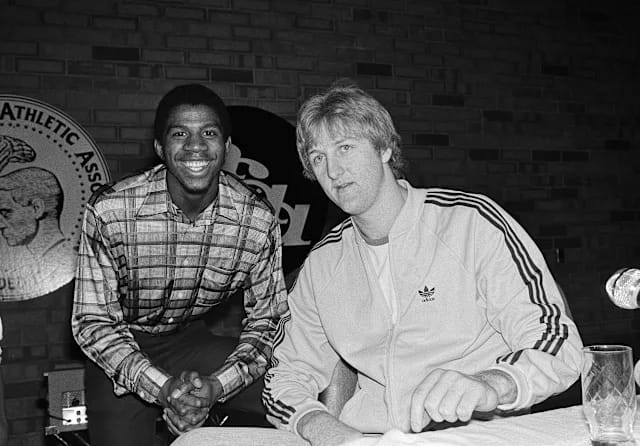
Larry Bird and Magic Johnson, whose 1979 championship meeting became a defining March Madness moment.
A matchup becomes a broadcast test
The 1979 final presented a clean proposition. An undefeated Indiana State team led by Bird against a Michigan State team led by Johnson, with the title attached and no extra context required.
The tension was that the tournament needed the moment to hold at scale. It wasn’t enough for arenas to care. The sport needed a night that felt national in living rooms, the kind of broadcast that makes a tournament easier to sell and easier to schedule around in the years that follow.
The game delivered that audience. NBC’s telecast drew a 24.1 Nielsen rating, often cited as the highest television rating for a college basketball game. What mattered underneath the number was the proof it represented, that the tournament could produce a truly mass audience when the bracket aligned the right story.
When March became a media product
After 1979, college basketball had a clearer reference point for what the tournament could be at its peak. The Bird–Johnson matchup became part of the sport’s argument that March belonged on the national calendar, not only as tradition, but as a repeatable event that could justify serious television attention.
The sport did not lose its regional identity. It added a national layer, one that could arrive quickly when the bracket created a simple story with real stakes.
A single game cannot explain everything that followed. But it can establish a ceiling that changes how everyone negotiates, how the tournament is framed, and how much value is assigned to three weeks in the spring.