- The Defining Moment
- Posts
- The Shoe Deal That Priced Attention
The Shoe Deal That Priced Attention
A deal that changed who gets paid when attention moves.
The Pitch
The Nike agreement with Michael Jordan is often remembered as the start of a sneaker era. It began, more plainly, as a pricing problem.
In 1984, before Jordan had played an NBA regular-season game, Nike negotiated as if his value might not be contained by performance alone. The deal is widely described as a five-year agreement worth about $2.5 million, an unusually large commitment for a rookie.
Nike also structured the relationship to allow additional upside as the product succeeded, rather than treating the endorsement as a fixed fee that ended with the signature.
Before the Deal
Basketball endorsements already existed, but the model was straightforward. Brands paid athletes to appear, promote, and lend credibility. The brand stayed at the center. The athlete was the face, but rarely the architecture.
Nike’s bet shifted the center of gravity. It wasn’t only associating with a sport or a team. It was building a product identity around one person.
That concentrated risk. It also created a new possibility: that an athlete’s name could function as a durable commercial platform, capable of compounding over time instead of resetting each season.
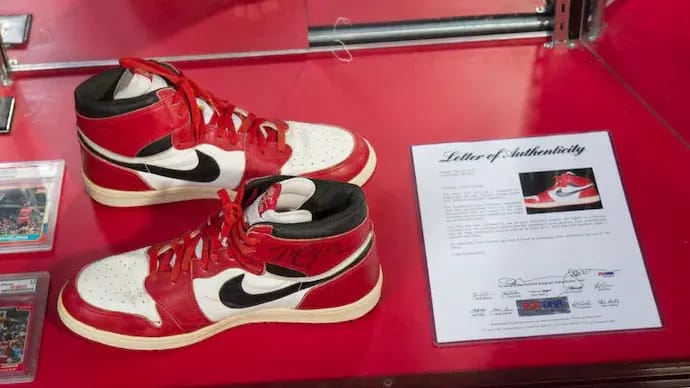
The Air Jordan 1, designed by Peter Moore and released in 1985 for $65.
The Friction
The early years carried a second tension: enforcement. League uniform rules around sneaker colors were real, but the familiar “banned” story is often told as a clean myth.
Nike’s own account describes something more layered. The black-and-red Air Jordan 1 became the symbol. But Nike has said the Nike Air Ship was the original shoe that drew league attention in the 1984–85 preseason.
Nike also references an official league letter dated February 25, 1985 citing uniformity violations. The company later embraced the controversy as marketing when the first Air Jordan reached the public in the spring of 1985.
The point was not rebellion for its own sake. It was evidence of how quickly a consumer narrative could form, and how difficult it was for a rulebook to contain demand once attention moved.
The New Baseline
When the first Air Jordan launched in the spring of 1985, sales arrived at a scale that made the old endorsement model feel small. Reporting from ESPN has described roughly $70 million in sales by May 1985 and more than $100 million by the end of that year.
Over time, the relationship hardened into a category. Nike’s investor communications describe Jordan Brand as being created in 1997 as a division within Nike, formalizing what the market had already begun to understand.
The enduring change was not the shoe itself. It was the precedent.
An athlete’s name could operate as a business line. Participation in the value created could be negotiated. And the marketplace would reorganize around that possibility, treating it less like an exception and more like a baseline.