- The Defining Moment
- Posts
- The TV Deal That Repriced the Dodgers
The TV Deal That Repriced the Dodgers
A record local contract, a long carriage fight, and a new definition of “rich team.”
The Deal That Moved TV to the Center
On January 28, 2013, the Los Angeles Dodgers and Time Warner Cable announced a long-term local television rights agreement built around a new regional sports network, SportsNet LA, expected to carry games beginning in 2014.
It came soon after Guggenheim Baseball Management took control of the franchise in 2012. The message, even then, was plain. Local television would no longer sit in the background as a nice advantage. It would sit in the foreground as the business plan.
When Distribution Still Held the Power
Local baseball television money had always mattered, but it was usually mediated by the cable bundle. Teams owned the games, yet distributors controlled the guide, the tiers, the monthly bill, and whether a channel would actually land in most homes.
That dynamic shaped leverage. Clubs could promise reliable programming and a loyal audience. Distributors could slow-walk carriage, demand different terms, or decide a channel cost too much to include widely.
In that world, “rich” tended to mean a mix of market size, sponsorship scale, and occasional spending runs. Local rights could lift a budget, but they rarely felt like a single agreement that could set a long-term operating floor.
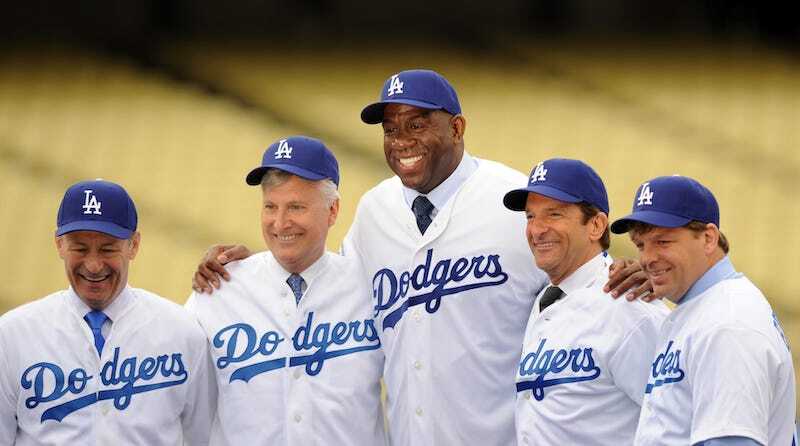
Mark Walter’s Guggenheim group, with Magic Johnson, bought the Dodgers from Frank McCourt in 2012 for $2.15 billion.
A Billion-Dollar Contract No One Could Watch
SportsNet LA launched in 2014, and the contract was real. What was not immediate was broad access.
Carriage talks with other providers hardened, and major distributors in the region did not carry the channel for years, with DirecTV widely cited as the most prominent holdout. For long stretches, large parts of the market could not simply turn on the television and find Dodgers games where local sports usually lived.
That friction exposed what a local rights deal actually depends on. A contract can be negotiated and priced upstream, between a rights holder and a cable company, while the lived experience of it remains downstream, at the level of what appears on a channel lineup.
It also kept the deal from being a clean victory story. The valuation had been established early. The practical meaning of “local” still had to be negotiated the hard way.
When Media Revenue Became Infrastructure
Over time, the agreement helped reset what a financial advantage could look like in baseball. A large market was not only a larger audience. It was the ability to convert that audience into long-duration media income that could be counted year after year.
The deal is often discussed alongside the Dodgers’ capacity, in later seasons, to sustain top-tier payroll commitments. It did not dictate individual roster decisions, but it widened the margin for them, and it changed how other teams talked about the gap between a good year and a durable payroll base.
The leverage shift was real, but uneven. Teams gained strength when local rights were priced as long-term assets. Distributors still held the practical control that matters most in the moment, whether the broadcast is easy to find, and on what terms.
On April 1, 2020, Spectrum Networks announced a carriage agreement bringing SportsNet LA to AT&T video platforms, including DirecTV. The standoff ended not with a redefinition of value, but with a resolution about distribution.
The deal’s legacy sits in that narrow space between finance and access. The money can look permanent on paper, while the path to the game can remain conditional.