- The Defining Moment
- Posts
- The Year Baseball Canceled October
The Year Baseball Canceled October
The 1994 strike didn’t just stop games. It reset labor power, strained trust, and changed what the sport could risk.
When the calendar lost its guarantee
On September 14, 1994, Major League Baseball canceled the rest of the season, including the postseason and the World Series. It was the first time the World Series had been canceled since 1904, and it changed the sport’s relationship with its own calendar.
The strike itself had begun on August 12. By mid-September, baseball’s most valuable ritual was no longer treated as inevitable.
Growth, and a fight over who owned it
The dispute was economic at its core, even when it sounded like a battle of principles. Owners, led publicly by acting commissioner Bud Selig, pushed for a salary cap and related controls. The players’ union, led by executive director Don Fehr, saw that framework as a shift in power dressed up as a financial fix.
Baseball’s revenue model was already pulling unevenly. Local television deals and market differences were widening the distance between clubs, and the bargaining question underneath the language was blunt. Who would be protected from that unevenness, and who would pay to correct it.
Before the strike, leverage often looked like time. Owners could wait. Players could miss paychecks. Both sides could assume the season’s structure would eventually force compromise.
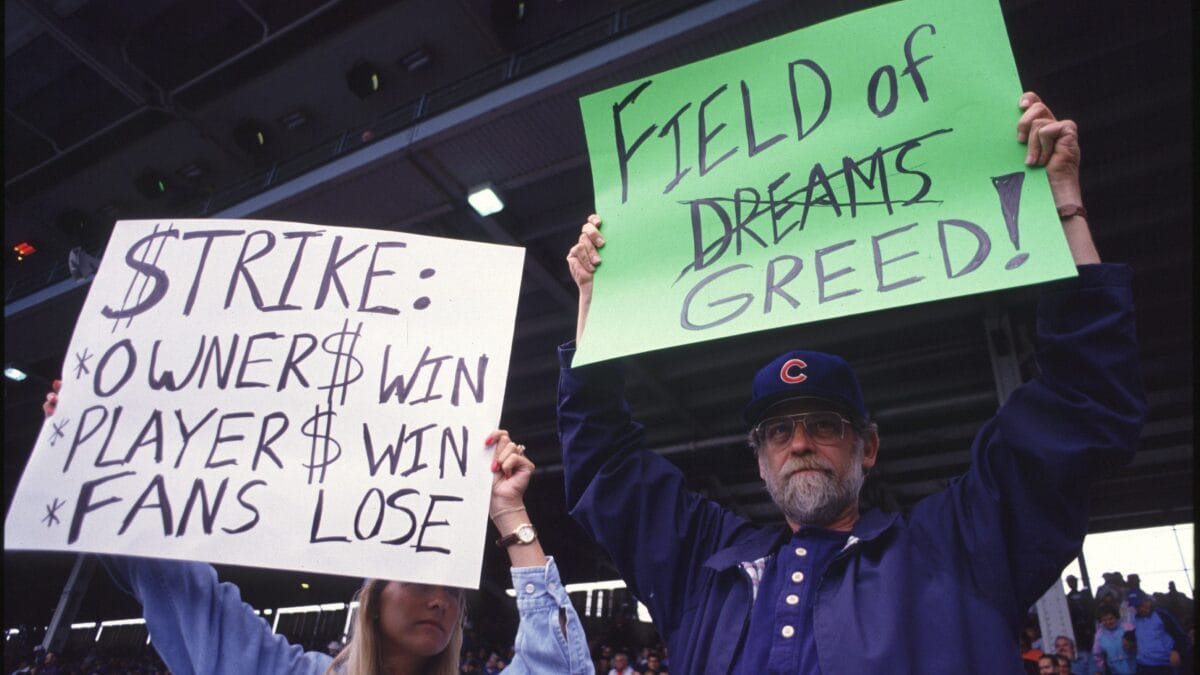
Fans react during the 1994 MLB strike, when the season ended without a postseason or World Series.
Labor power meets the sport’s centerpiece
Once games stopped, the calendar became both weapon and risk. For the union, withholding labor was the only tool strong enough to resist a cap. For the league, canceling the World Series signaled a willingness to absorb damage in order to change the rules.
The tension wasn’t confined to owners and players. It ran through the audience. A work stoppage can be “won” at the table and still weaken the product, because the cost is paid in habit, trust, and attention.
That dynamic sharpened when the league moved toward replacement players for the start of the 1995 season, a plan approved in January 1995. The confrontation stopped feeling technical. It began to look like a test of whether the sport would proceed without its labor force, and what that would do to the sport’s credibility.
After trust is spent
On March 31, 1995, U.S. District Court Judge Sonia Sotomayor issued a preliminary injunction that blocked the owners from unilaterally imposing new terms. The strike ended on April 2, and the 1995 season was played as a shortened 144-game schedule.
Baseball returned, but the relationship had changed. The union demonstrated it could halt the industry at its most visible point. Ownership demonstrated it would threaten the crown jewel. The cost of escalation was now part of the sport’s operating reality.
The underlying economic arguments did not disappear. They resurfaced in later bargaining cycles, alongside new revenue streams and new distribution methods. But after 1994, the sport carried an added layer of memory, the knowledge that a season can be withheld, and that the collateral damage is shared.
A canceled World Series did not settle the questions. It reset the price of asking them.